
Before anyone hands an immigration consultant their passport, their savings and their family's future, they check them out. The first place they look is the website. Increasingly, the second place is the regulator's public register, to see whether the person on that website is who they say they are.
That makes an immigration consultant website different from an ordinary business website. It is a sales page, but it is also a regulated piece of advertising, and in Canada and the UK the rules for it are written down. This article sets out what those rules actually require, the mistakes that show up on consultancy websites again and again, and the trust signals that turn a nervous visitor into an enquiry.
This is a practical summary, not legal advice. Your regulator's code and guidance are the final word, and they are linked at the end.
Canada: what an RCIC's website has to show
Regulated Canadian immigration consultants (RCICs) are governed by the Code of Professional Conduct for College of Immigration and Citizenship Consultants Licensees (SOR/2022-128). Sections 44 to 46 cover marketing, and a website is marketing.
Section 44(1) says a licensee who markets their services must ensure that:
- Their name, as registered with the College, is prominently displayed, not hidden in the footer or replaced by a brand name alone
- Any written advertisement includes the internet address of the College's online public register, which is register.college-ic.ca
- The marketing is in the best interests of the public and consistent with a high standard of professionalism
Section 44(2) then lists what a licensee must not do:
- Make false, misleading or inaccurate representations
- Guarantee the success of an application, expression of interest or proceeding
- Imply a relationship with the Government of Canada or a provincial government
Section 45 covers testimonials: a client endorsement may only be used if it was actually given by a client, is true and accurate, and the client has approved it for public use in writing. Section 46 says the College's name and logo may only be used as the College permits.
The register link is the requirement most consultancy websites miss. It is also the cheapest one to fix, and it works in your favour: a visitor who can confirm your licence in ten seconds is a visitor who keeps reading.
United Kingdom: what an IAA-regulated adviser's website has to show
UK immigration advisers who are not solicitors or barristers are regulated by the Immigration Advice Authority (IAA, formerly the OISC). Its Code of Standards and its 2025 practice note on promotional material set out the rules.
- Display your IAA registration number (Code 6.1). The 2025 practice note goes further: your website and online presence should prominently display the IAA's regulatory details and your unique number, along with the IAA logo and digital badge, which helps visitors verify you
- Use the IAA logo only as your approval letter allows (Code 6.2)
- Don't publish success rates. Code 6.5 says you must not make promotional statements about your success rates, publicly, orally or in writing
- Don't criticise other advisers in promotional material (Code 6.4)
- Don't use a name that could confuse or mislead clients (Code 6.6)
- Show the registered company if you trade under a different name: the practice note says the website should include the details of the company registered at Companies House
- Don't make the organisation look bigger than it is, or describe its reputation in a potentially misleading way
- Testimonials must be volunteered freely by the client, the client should know it may appear on your website, and it must be accurate. The Commissioner can ask to see the case file behind it
The UK Code also requires a fee scale and reasonable fees (Code 9.1). That doesn't oblige you to publish prices on the website, but a clear explanation of how you charge is one of the strongest trust signals you can give.
Consultancies in India working on Canadian or UK files
Many Indian consultancies work alongside an RCIC or a UK-regulated adviser rather than holding the licence themselves. In that case the rules above apply to the regulated person, and your website is where clients will look for them. Name the licensed professional who handles the regulated work, show their registration number or register link, and be precise about who does what. Vague wording that lets a visitor assume the whole firm is licensed is exactly the kind of misleading impression both regulators prohibit.
The mistakes we see most often
| On the website | Why it's a problem |
|---|---|
| "100% visa success" or "guaranteed approval" | Guarantees are prohibited for RCICs, and success-rate claims are prohibited for IAA advisers |
| Licence number only in the footer, or nowhere | Canada requires your registered name prominently and the register link; the UK expects your number prominently |
| Government crests, "IRCC approved" or "Home Office partner" | Implying a government relationship is prohibited in Canada and misleading anywhere |
| Testimonials with stock photos and first names only | Both regulators require real, accurate endorsements the client agreed to, which you may be asked to evidence |
| A brand name with no person or company behind it | Visitors and regulators both need to see who is actually responsible for the advice |
| "Our team of 50 experts" for a three-person office | The UK practice note specifically warns against appearing larger than you are |
Beyond the rules: what makes a visitor trust you
Compliance gets you to neutral. These are the things that move a visitor to enquire:
- A named, photographed adviser. People hire a person, not a logo. A real photo and a short professional profile beat any stock image.
- A real office address and a phone number that is answered. Ideally with a map and opening hours.
- A clear "how we charge" page. Consultation fee, how service fees are structured, and what government fees are separate. Clients who understand the money ask better questions and complain less.
- Service pages written per visa type. A visitor searching for a UK Skilled Worker visa wants a page about that visa, not a list of twenty countries.
- A fast, mobile-first site on HTTPS. Most of your visitors arrive on a phone, many from a social media ad.
- A privacy policy that matches what you actually do with passport scans and documents.
- One obvious next step: book a consultation, or send an enquiry, on every page.
A website checklist for immigration consultants
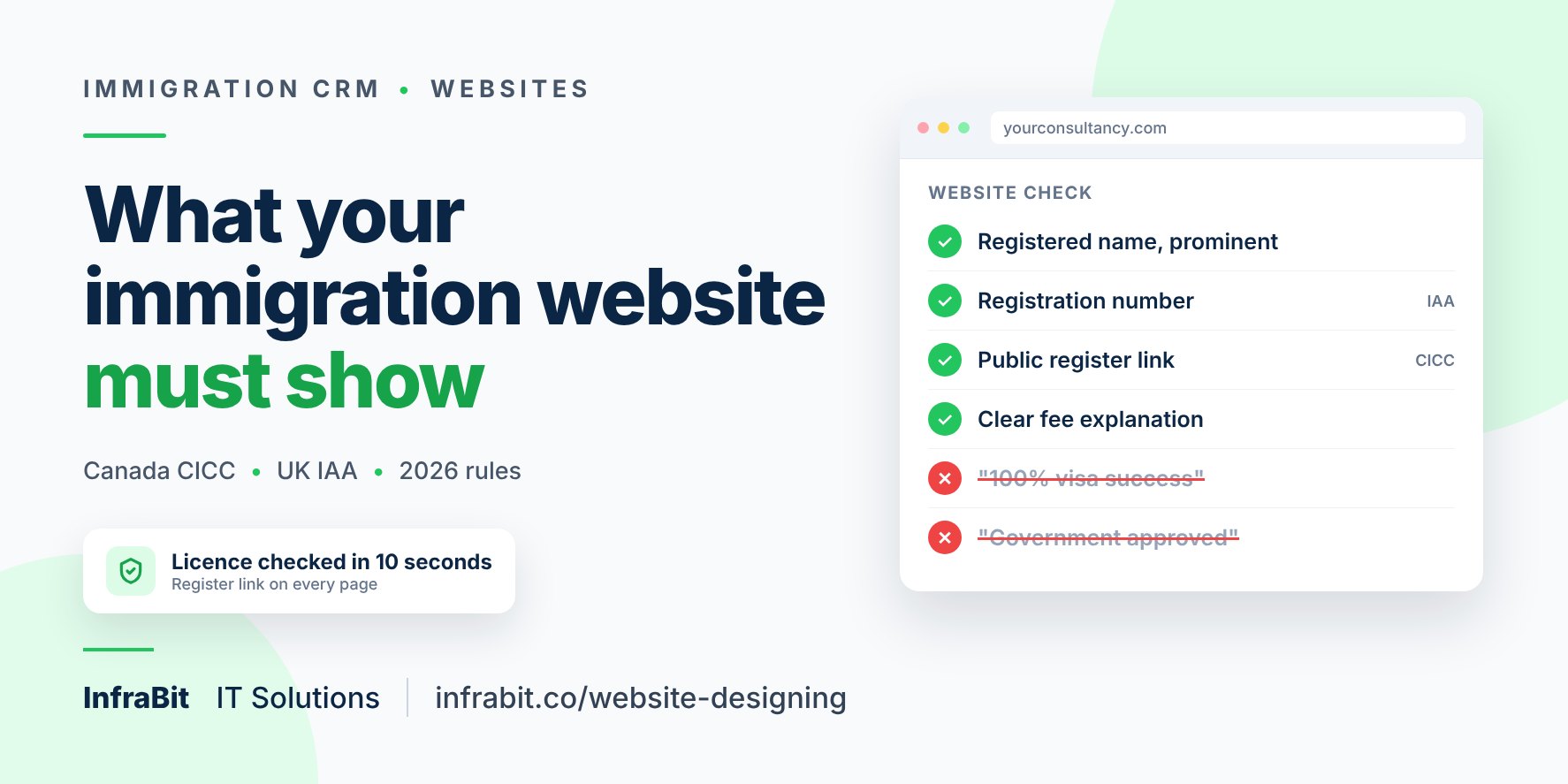
- Registered name of the licensed professional, prominent near the top of the page
- Registration number, plus a link to the regulator's public register (register.college-ic.ca or gov.uk/find-an-immigration-adviser)
- Regulator logo or badge, used only as permitted
- Registered company details if you trade under a different name
- No guarantees, no success rates, no implied government affiliation
- Testimonials you can evidence, with written client consent
- A clear explanation of fees
- Physical address, phone and a named adviser with a photo
- Privacy policy and HTTPS
- An enquiry form and a booking option on every page, connected to your CRM
Where InfraBit fits
We build websites for businesses, including immigration consultancies, through our website designing service. A standard business website typically goes live in one to three weeks, is fully responsive and comes with ongoing support. Tell us your regulator and we will build the registration details, register link and fee page into the design from the start, rather than squeezing them into the footer later. We are not lawyers, so the final compliance check belongs to you and your regulator's guidance.
If you already run InfraBit Immigration CRM, the website and the CRM work as one system. The embeddable enquiry form and appointment booking widget send every website enquiry straight into the CRM, with no retyping. On the Enterprise plan you can also track website visitors and give clients a portal login to check their case status. The details of that connection are in how your website should connect to your immigration CRM.
Frequently asked questions
Does an RCIC have to show their licence number on their website?
The Code of Professional Conduct does not require the licence number itself. Section 44 requires the licensee's name, as registered with the College, to be prominently displayed, and any written advertisement to include the internet address of the College's online public register. Many RCICs show their number as well, because it makes the register check instant.
Can an immigration consultant advertise a 100% success rate?
No. In Canada, section 44(2) of the Code prohibits licensees from guaranteeing the success of an application. In the UK, Code 6.5 of the IAA Code of Standards prohibits promotional statements about success rates. Both also prohibit misleading claims generally.
What does a UK immigration adviser need to display on their website?
Their IAA registration number (Code 6.1). The IAA's 2025 practice note on promotional material adds that the website should prominently display the IAA's regulatory details and the adviser's unique number, with the IAA logo and digital badge, and the details of the registered company where a different trading name is used.
Can I put client testimonials on my immigration website?
Yes, with care. In Canada the endorsement must be genuinely from a client, true and accurate, and approved by the client in writing for public use. In the UK it must be volunteered freely by the client, who should know it may appear on your website, and it must be accurate.
How do clients check whether an immigration consultant is licensed?
In Canada, on the College of Immigration and Citizenship Consultants public register at register.college-ic.ca. In the UK, with the IAA Adviser Finder at gov.uk/find-an-immigration-adviser. Solicitors and barristers are listed by their own professional bodies.
Sources: Code of Professional Conduct for College of Immigration and Citizenship Consultants Licensees, SOR/2022-128 (Canada Gazette) · IAA Code of Standards 2024 · IAA Promotional material practice note 2025 · CICC Public Register · IAA Adviser Finder