
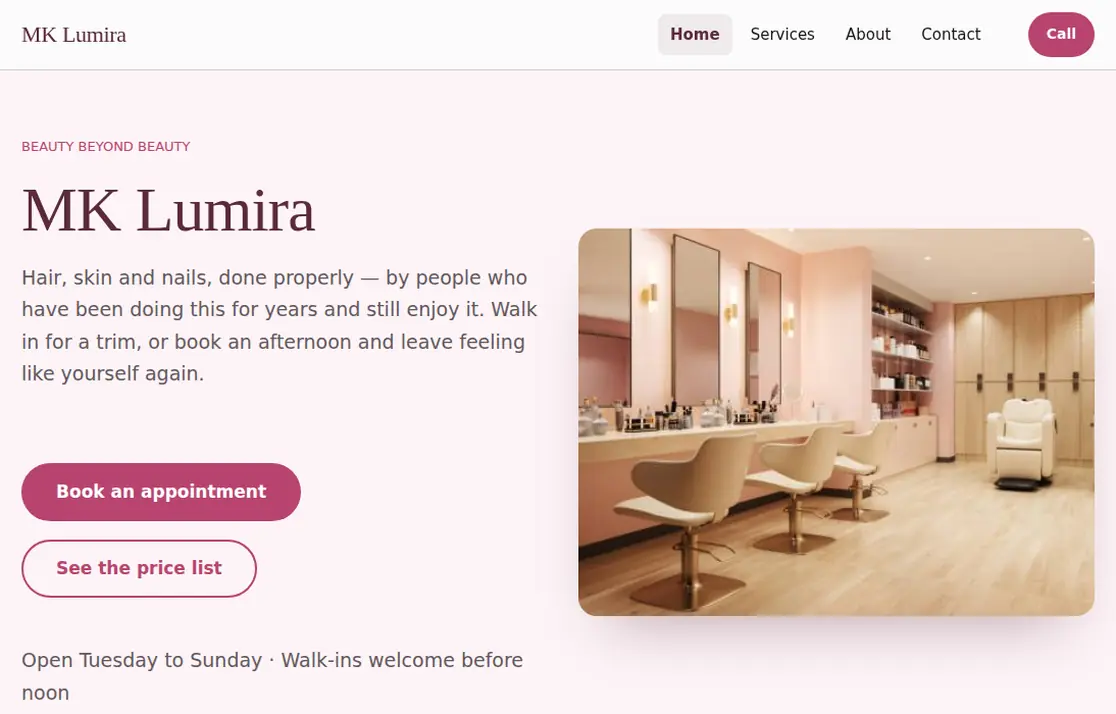
Most small businesses in India do not need a custom-built website. They need four honest pages, a phone number that works, and to stop losing customers who searched for them and found nothing. That is an afternoon of work, not a three-month project — provided you prepare the right things before you start.
This is a practical guide to doing it yourself. It also explains, near the end, when you should not: there are businesses for which a do-it-yourself site is the wrong answer, and it is worth knowing which side you are on before you spend the afternoon.
Prepare these six things first
Almost everyone who gets stuck halfway through gets stuck because they started without the content. The tool is not the hard part. Gather these into one document before you open anything:
- Your business name, exactly as you want it written. Including whether it is “&” or “and”. You will type it once and see it in forty places.
- A one-sentence description. What you do and who for. “Hair, skin and nails, done properly” beats “premium unisex salon offering world-class services” every time, because the first one sounds like a person.
- Your services, with prices if you are willing to publish them. Publishing prices filters out the people who were never going to book, which saves you the phone call.
- Opening hours and address. These matter more than you think — see the section on search below.
- Six to ten photographs. Of your actual premises, your actual work, your actual staff. A phone camera in daylight beats stock photography, and customers can tell the difference immediately.
- A phone number and an email address you check. A contact form that nobody reads is worse than no contact form.
The photographs are the bottleneck. If you have nothing usable, stop and take them first. An hour with a phone in good light will improve the finished site more than any other hour you spend on it.
What a template actually gives you
A template is not a colour scheme. A good one arrives as a complete website with real sentences already written in every section, so your job is editing rather than staring at an empty page.
The InfraBit Website Builder ships seven of them — beauty salon, restaurant, clinic, gym, coaching classes, wedding photography, and chartered accountant or legal practice. Each is four pages: Home, a services or menu page, About, and Contact with a map and an enquiry form.
Pick the one closest to your trade even if the fit is not exact. A physiotherapist is better off starting from the clinic template than from a blank page, because the structure of the argument — what you do, what it costs, why you can be trusted, how to reach you — is the same.
Write like you talk
The single biggest difference between a small-business site that works and one that does not is the writing, and it costs nothing to get right.
- Say the specific thing. “Twelve students per batch” is worth more than “small batch sizes”. “Open until 8pm, walk-ins welcome before noon” is worth more than “flexible timings”.
- Answer the question they actually have. What does it cost, how long does it take, do I need an appointment, where do I park. Most business sites answer none of these.
- Cut every sentence that could appear on a competitor’s site unchanged. “We are committed to excellence” describes nobody.
Being found afterwards
A website nobody can find is an expensive business card. Two things matter far more than the rest for a local business:
Your business details, in a format search engines read
When you fill in your address, phone number and opening hours, a well-built site also writes them into the page as structured data. That is what allows Google to show your hours and phone number directly in the results rather than just a blue link. It is not a ranking trick — it is making the information machine-readable, and most hand-built sites skip it entirely.
A Google Business Profile
For a local business this is arguably more important than the website itself, and it is free. Claim it, add the same hours and phone number as your site, and add photographs. Consistency between the two is what builds confidence that you are a real business at a real address.
If you want help with the wider picture once the site is live, that is what our digital marketing services are for. But do the free things first.
Be sceptical of anyone promising rankings. Nobody controls what Google shows, including us. What you can control is whether your information is complete, accurate and readable — which is most of the battle for a local search.
What it costs
Here is the honest version, for our builder specifically.
| Free | Paid | |
|---|---|---|
| Build and publish | Yes, unlimited pages | Yes |
| Address | A free yourname.sites.infrabit.co subdomain | Your own domain |
| Badge | A small InfraBit badge on the page | Removed |
| HTTPS | Not yet on free subdomains | Free SSL on your domain |
| Backups | — | Included |
| Price | Nothing, no card needed | ₹7,000 per year plus GST |
The free tier is not a trial. You can build a complete site, publish it and leave it there indefinitely. You pay when you want your own domain name on it, and there is a full refund within fourteen days if you change your mind.
When you should not do it yourself
Three honest cases where a do-it-yourself site is the wrong tool:
- You need to sell online with a cart, stock and payments. That is a different kind of software and a template will fight you.
- Your website is the product. If customers judge you on design — a studio, an agency, a luxury brand — the marginal look of a template will cost you more than the build would have.
- You genuinely do not have the afternoon. This is the most common one, and there is no shame in it. If your time is worth more running the business, have someone build it: that is what our website design service exists for.
Frequently asked questions
How long does it really take to build a business website yourself?
About ten minutes to have something real on screen from a template, and an afternoon to have it genuinely finished with your own words and photographs. The gap between those two numbers is almost entirely writing and choosing pictures, which is why preparing your content first makes such a difference.
Do I need to know how to code?
No. A drag-and-drop editor changes text, photographs, colours, sections and pages without any code. You do not need to understand hosting, DNS or SSL certificates either, because those are handled for you.
Can I use my own domain name?
Yes, on the paid plan. You can connect a domain you already own, and a free SSL certificate is issued for it so the site loads over HTTPS. On the free plan your site lives at a yourname.sites.infrabit.co address instead.
What happens to my website if I stop paying?
The site is not deleted. It reverts to the free subdomain address with the badge shown again, and your content stays as you left it. You can pay again later and reconnect your domain.
Is a free website good enough for a small business?
For testing an idea, or for a business whose customers mostly arrive through WhatsApp and word of mouth, yes. Once you are printing the address on a signboard or a visiting card, a domain of your own is worth the money — it is what makes you look like a business rather than a hobby.
Can I move my website somewhere else later?
Your domain is yours and your enquiry messages can be exported at any time. You are not locked in by anything other than the effort of rebuilding, which is the same with any hosted builder.
Start with the content, not the tool
If you take one thing from this: open a document, write the six items from the first section, and find your photographs. Do that and the website itself is an afternoon. Skip it and you will be staring at a half-finished page at midnight wondering what to write about your own business.
When you are ready, you can start building for free — no card, and you can see how it looks before you decide anything.