
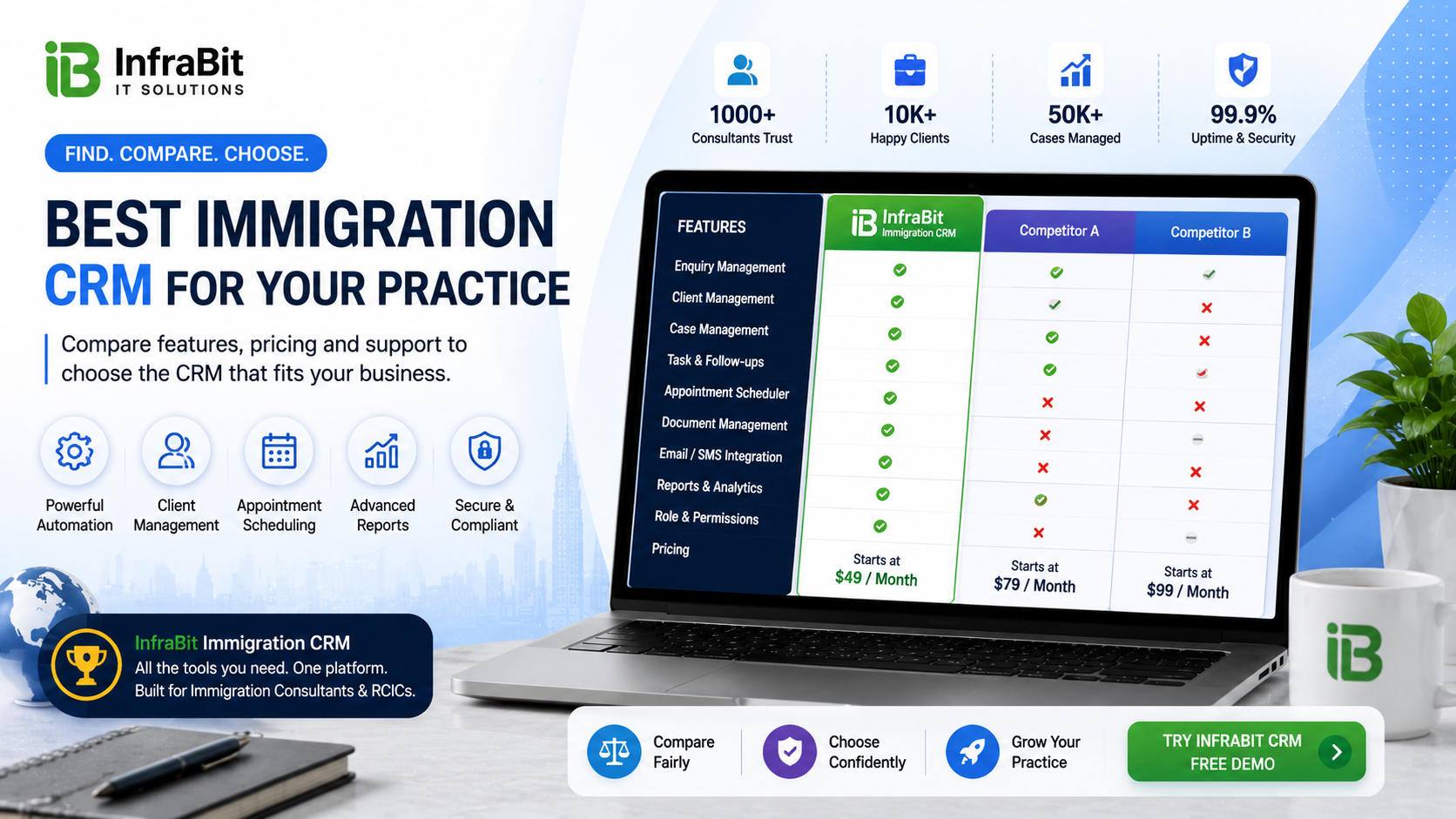
Regulated Canadian Immigration Consultants shop for software in a market very different from the rest of the world: CICC professional obligations, IMM forms, IRCC portals, retainer agreements, and — for many practices — a steady flow of cases referred by agents in India and abroad. This 2026 guide compares the tools RCICs actually evaluate, including where each genuinely wins, so you can match the software to the way your practice really runs.
Best CRM & practice software for RCICs in Canada (2026)
| Software | Model | Best for | Standout | Watch out for |
|---|---|---|---|---|
| InfraBit Immigration CRM | White-label branding, hosted by InfraBit; monthly, half-yearly or yearly | RCICs who want to own their platform, brand and data — especially practices working with agent networks abroad | Visa milestone pipeline, encrypted IRCC/GCKey credentials vault, client portal, e-sign retainers, B2B partner portal, English + French + 3 more languages | Practice CRM rather than a form-filing tool — no IMM form autofill |
| VisaFlo | SaaS subscription | Filing-heavy practices | IMM form autofill and IRCC portal workflows with practitioner review | Canada-filing focus; less emphasis on marketing/lead side |
| Officio | SaaS subscription | Established RCIC offices | Long-standing Canadian practice management name | Subscription per user; vendor-hosted data |
| CaseEasy | SaaS subscription | Solo and small RCIC practices | Canada-specific case workflows | Scaling costs as the team grows |
| Clio (Manage) | SaaS, USD per-user tiers | Mixed RCIC + lawyer firms | Trust accounting and legal-practice depth | Immigration is one practice area among many; USD $59–149/user/mo adds up |
| Maple CRM | SaaS subscription | Consultancies with India-side operations | Mature lead-to-case workflow, popular with overseas-education firms | Vendor-hosted; per-user pricing |
| HubSpot / Zoho (customised) | SaaS subscription | Firms with budget for custom builds | Automation ecosystems | Nothing immigration-specific until you build it |
Honest note: if your bottleneck is filling IMM forms faster, a filing tool like VisaFlo solves that specific problem. If your bottleneck is leads, client experience, agents and running the practice — that’s CRM territory, and it’s where the rest of this guide focuses. Many practices pair one of each.
What an RCIC practice actually needs from a CRM
- Case milestones mapped to Canadian streams — Express Entry, PNP, spousal sponsorship, study and work permits, visitor visas — with a pipeline view of every file’s stage from consultation to decision.
- An encrypted credentials vault — IRCC portal and GCKey logins protected with role-based access, never a shared spreadsheet.
- E-sign retainer agreements — signed digitally at engagement, stored on the file.
- A client portal — document checklists, uploads and status visibility that cut the “any update?” emails.
- B2B agent management — if sub-agents in India, the Gulf or elsewhere refer cases to you, they need their own logins and pipeline visibility instead of WhatsApp threads.
- French for Quebec and francophone clients — a CRM your Montreal or Gatineau clients can use in French widens your market immediately.
- Data ownership — CICC obligations make it worth asking any vendor: where does client data live, and can you take all of it with you?
The ownership question: per-user SaaS vs your own platform
Most Canadian options price in USD per user per month — a three-person practice on a mid-tier plan can spend thousands of dollars a year, forever, for software that carries the vendor’s brand and holds the practice’s data. The white-label alternative flips this: InfraBit deploys the CRM on a branded subdomain we host — your clients log in at yourfirm.infrabit.co — with your branding, your database, optional sync of backups to your own Google Drive, on a monthly, half-yearly or yearly plan. For a practice planning to operate for years, the economics and the independence both favour ownership.
Built for how Canadian files actually arrive
✓ Run by real Canadian-market practices: Always Canada Group, a Mississauga-based licensed RCIC practice, and Hannes Immigration, serving francophone applicants, both operate on InfraBit Immigration CRM — alongside consultancies across India that refer Canada-bound cases.
A large share of Canadian immigration files start with an agent abroad. InfraBit’s B2B partner portal gives your referral agents their own logins to submit and track cases — while the client portal, automated welcome emails and e-sign retainers, visual case milestone tracking, IRCC/GCKey vault and Google Calendar appointment sync run your Canadian side. The interface works in English, French, Spanish, Dutch and Russian. See transparent pricing, or compare the wider market in our 2026 buyer's guide, the India edition of this guide, and the 7-point selection framework.
Frequently asked questions
What is the best CRM for RCICs in Canada?
For your own branding, your own client data and agent networks with a client portal — InfraBit Immigration CRM is the strongest option in 2026. For IMM form autofill specifically, filing-focused tools like VisaFlo lead; for trust accounting in mixed legal practices, Clio is the benchmark. Many firms combine a CRM with a filing tool.
Does InfraBit fill IMM forms automatically?
No — InfraBit is a practice CRM covering leads, cases, milestones, credentials, retainers, clients and agents. Practices that want form autofill typically pair InfraBit with a dedicated filing tool.
Does it work in French?
Yes. The interface supports French along with English, Spanish, Dutch and Russian — useful for Quebec-based clients and francophone applicants.
What does an immigration CRM cost in Canada?
Canadian SaaS options typically run USD $50–150 per user per month. InfraBit offers monthly, half-yearly and yearly plans — full details on the pricing page.