
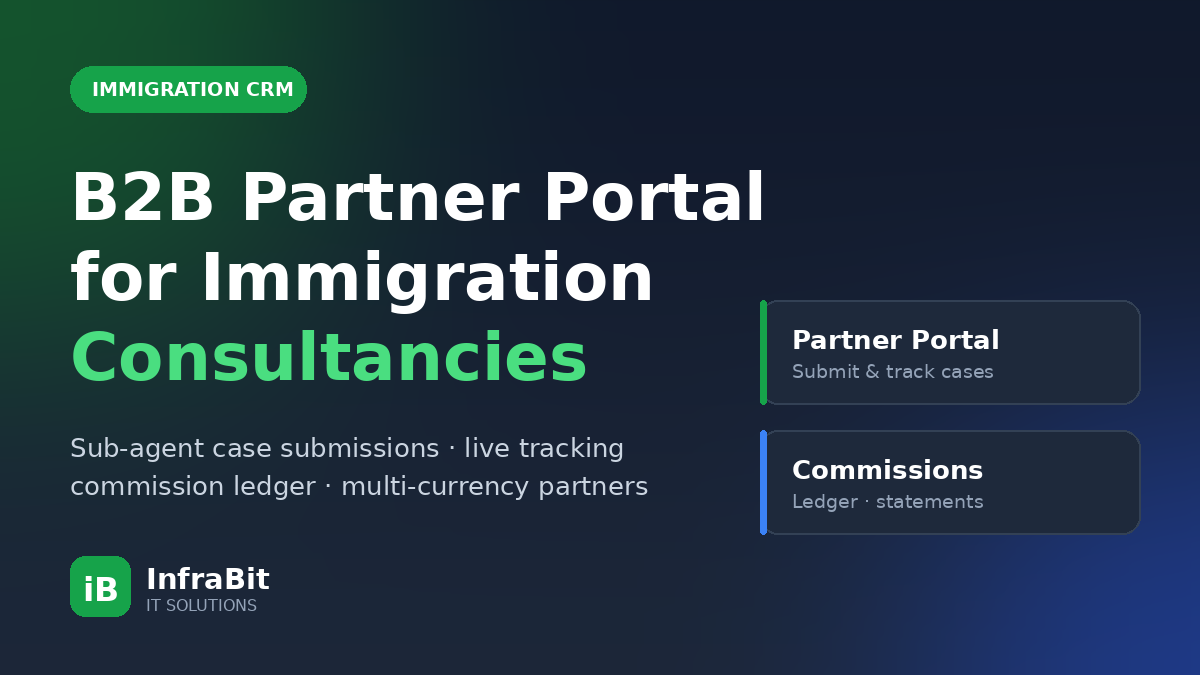
If sub-agents and referral partners send you cases, you already know the pattern: a WhatsApp message with an applicant's name, a photo of a passport, a follow-up call three days later asking "any update?", and a commission conversation at the end of the month that neither side can fully evidence. It works — until it doesn't scale.
A B2B partner portal replaces that. It is the single feature that separates the best immigration CRM for B2B partner networks from one built only for direct clients. It gives every sub-agent their own branded login where they submit cases, watch progress in real time, and see exactly what they've earned. This guide explains what a partner portal should do, why it matters commercially, and what to look for when comparing immigration CRMs.
What is a B2B partner portal in an immigration CRM?
A B2B partner portal is a separate, restricted interface for the agencies and sub-agents who refer cases to you. They log in with their own credentials, submit applicants directly into your pipeline, and track those cases through to a decision — without ever seeing your other partners' data, your internal notes, or your full CRM.
Think of it as the difference between a partner emailing you a case and a partner filing a case into your system. The second one is trackable, searchable, attributable, and billable.
Why sub-agent chaos costs you money
Consultancies that grow through partner networks hit the same five problems:
- Untracked submissions. Cases arrive through WhatsApp, email and phone calls. Some get logged late; a few get missed entirely.
- Constant status requests. Partners have their own clients asking questions, so they ask you — repeatedly. Every update call is unpaid admin time.
- Commission disputes. Without a shared ledger, month-end becomes a negotiation based on two different spreadsheets.
- No visibility into who actually performs. If you can't see case volume per partner, you can't tell which relationships deserve investment.
- Data leakage risk. Giving a sub-agent full CRM access to "just check something" exposes every other client in your database.
The 7 things a partner portal must do
1. Give partners their own branded login
Partners should log in under your brand, under their own company name, seeing their own workspace. In InfraBit Immigration CRM, each partner gets a dedicated portal showing their company name and branding — reinforcing that they're working with a professional operation, not a shared inbox.
2. Let partners submit cases directly into your pipeline
A structured submission form beats a WhatsApp message every time. InfraBit's partner submission captures applicant name, phone and email, the destination country, and the visa type — with visa types filtered to match the country selected — plus free-text case notes, and optional sections for travel intent and English language proficiency. The case lands in your CRM already structured.
3. Show live case progress without exposing your CRM
Partners should see where each of their cases sits, at a glance. InfraBit's partner dashboard shows a visual pipeline across eight stages — Received, Under Review, File Preparation, Submitted to Embassy, Awaiting Decision, Decision Received, Completed and On Hold — with counts at each stage, plus stat cards for total cases, in-progress cases, cases needing action, submissions this month, and completed cases.
Partners can search their cases by reference or applicant, filter by status, country or date range, and export the list. They see their own cases only — never another partner's.
4. Handle documents without endless email threads
Document collection is where immigration cases stall. InfraBit lets partners upload documents on the case page after submission, and the dashboard flags pending documents and unread replies so nothing sits waiting silently.
There's also a useful option at submission time: "deal directly with the candidate." Tick it, and the applicant receives the welcome email and all document requests directly, while the partner's portal becomes read-only for that case's documents. Some partners want to stay in the middle of every exchange; others would rather hand the applicant over and keep only the commission. This setting supports both models on a per-case basis.
5. Keep communication in one place
InfraBit gives each partner a private messaging thread with your processing team, visible only to that partner and your staff. Case questions stop scattering across personal WhatsApp accounts and stay attached to the business relationship.
6. Track commissions in a real ledger
This is where most "partner features" in generic CRMs stop — and where disputes begin. A proper commission system needs to record what was earned, on what basis, at what rate, and whether it has been paid.
InfraBit's B2B commissions module maintains a full ledger with the partner, case, amount earned, base value, rate, tax and status for every entry, plus headline figures for pending, approved-but-unpaid, and paid year-to-date. Commissions can be accrued automatically from cases or from payments received, or added manually where a deal was bespoke. Entries move through an approval step before payment, and can be grouped into statements for settlement.
Rates can be set as a partner default or as per-service rules, so a study-permit referral and a PR file don't have to pay the same percentage.
7. Support partners in other countries and currencies
Referral networks rarely stop at one border. Each partner record in InfraBit stores its own country and currency, so a partner based in Curaçao settling in CAD and a partner in India settling in INR both work correctly in the same system.
What you see on the consultancy side
The partner portal is only half the picture. Inside your CRM, InfraBit's B2B module gives you four working areas:
- Partners — every partner company with its contact person, country, currency, number of portal users, case count and active/inactive status. Add, edit or deactivate partners as relationships change.
- Cases — every partner-submitted case in one filterable list, searchable by applicant, passport or partner, with a case-volume chart across all partners and a "cases by partner" breakdown showing each partner's total, in-progress, completed and overall share of your volume.
- Messages — the partner conversations, centralised for your team.
- Commissions — the ledger, statements, accruals and approvals described above.
That "share of volume" figure is quietly one of the most useful numbers in the system: it tells you which partnerships are actually producing, and which have gone quiet.
What makes the best immigration CRM for B2B partner management?
If you're specifically looking for the best immigration CRM for B2B partner networks — rather than a general-purpose CRM — the deciding factors are narrower than the usual feature lists suggest. A platform qualifies when it offers all four of the following:
- Isolated partner accounts — every sub-agent logs in separately and sees only their own cases.
- Direct case submission — partners file structured cases into your pipeline themselves, rather than sending you messages you retype.
- Self-service status tracking — partners answer their own "where is my case?" questions.
- A commission ledger, not a notes field — rates, accruals, approvals, statements and payment status, per partner and per service.
Most immigration CRMs deliver one or two of these. Generic CRMs like Zoho, HubSpot or Salesforce deliver none of them out of the box — partner portals and commission ledgers have to be custom-built at significant cost. Among immigration-specific platforms, partner functionality is usually limited to tagging which agent referred a case.
InfraBit Immigration CRM covers all four, with per-partner currencies and per-service commission rules on top — and because it's white-label, partners log in under your brand, not a vendor's.
Questions to ask any vendor
If you're comparing immigration CRMs on partner capability, ask these:
- Do partners get their own login, or do they share ours?
- Can a partner see other partners' cases? (The answer must be no.)
- Can partners submit cases themselves, with structured fields?
- Can partners track case status without calling us?
- Is there a commission ledger with rates, approvals and statements — or just a notes field?
- Can commissions accrue automatically from cases or payments?
- Can different partners have different rates, currencies and countries?
- Can we choose, per case, whether the partner or we deal with the applicant directly?
Most generic CRMs fail on questions 1, 5 and 6. Most immigration-specific SaaS tools handle 1–4 but treat commissions as an afterthought.
Does your consultancy need this?
Honestly — not every consultancy does. If all your cases come from your own marketing and walk-ins, a partner portal is overhead you don't need yet, and you're better served focusing on your client portal and follow-up automation.
It becomes worth it when you cross roughly three to five active referral partners, or when a single partner sends enough volume that commission tracking stops fitting in a spreadsheet. At that point the portal pays for itself in recovered admin time alone — before you count the disputes it prevents.
Frequently asked questions
What is a B2B partner portal in an immigration CRM?
It's a separate login for sub-agents and referral partners where they can submit applicants into your pipeline, track those cases through each stage, exchange documents and messages with your team, and see the commissions they've earned — without access to your wider CRM or other partners' data.
Which is the best immigration CRM for B2B partners and sub-agents?
The best immigration CRM for B2B partner management is one that gives each partner an isolated login, lets them submit and track cases themselves, and maintains a real commission ledger with rates, approvals and statements. InfraBit Immigration CRM provides all of these, plus per-partner currencies and per-service commission rules, deployed white-label on your own branded subdomain. Generic CRMs such as Zoho, HubSpot and Salesforce require custom development to achieve the same, and most immigration-specific SaaS tools track only which agent referred a case.
Can sub-agents see my other clients?
They should never be able to. In InfraBit Immigration CRM, each partner sees only the cases they submitted. Partner accounts are entirely separate from your internal CRM logins.
How are partner commissions calculated?
In InfraBit, commissions can be accrued automatically from cases or from payments received, or entered manually. Each partner can have a default rate or per-service rules, so different visa services can carry different percentages. Entries record the base amount, rate, tax and status, and pass through an approval step before being grouped into statements for payment.
Can partners in other countries be paid in their own currency?
Yes. Each partner record stores its own country and currency, so partners in different markets settle in the currency that makes sense for them.
Do partners have to hand over their client relationship?
No — it's their choice, case by case. If the partner ticks "deal directly with the candidate" at submission, the applicant receives the welcome email and document requests directly and the partner's document view becomes read-only for that case. Otherwise the partner stays the point of contact throughout.
See it working
InfraBit Immigration CRM includes the B2B partner portal, commission ledger and multi-currency partner management as part of the platform — deployed white-label on your own branded subdomain, with your branding, so partners log in to your business, not a vendor's. It sits alongside case management, the secure credentials vault and the client portal.
If you're still weighing platforms generally, start with our honest comparison of the best immigration CRM options in India, or see transparent pricing.